The Problem
Blockchain networks expose large volumes of on-chain data, but most users lack accessible interfaces to interpret and interact with that data effectively. Traditional block explorers focus on raw transaction visibility but fail to provide actionable tooling for managing resources or executing common operations.
In ecosystems like Vaulta (built on Antelope.io software stack), users must understand concepts such as CPU, NET, and RAM to operate effectively. These abstractions introduce friction, particularly for non-technical users.
Additionally, essential actions such as token swaps or resource management are often fragmented across multiple tools, requiring users to switch between interfaces and increasing the risk of errors.
The result is a disconnect between blockchain transparency and practical usability.
The Solution
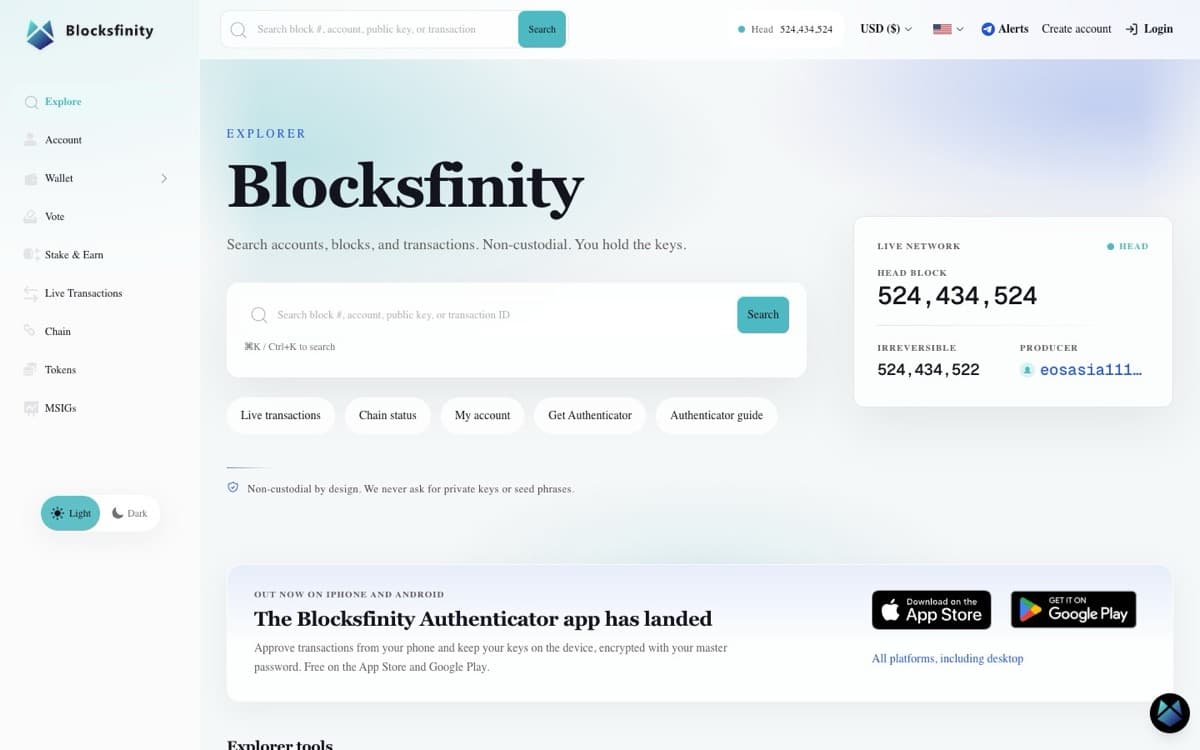
Blocksfinity.com introduces a unified interface that combines blockchain exploration with direct on-chain interaction. The platform enables users to inspect, manage, and interact with on-chain data in a single environment, reducing friction and improving usability.
- Blockchain Explorer: Real-time access to transactions, accounts, and on-chain activity within the Vaulta ecosystem
- Resource Management: Direct interaction with CPU, NET, and RAM resources, allowing users to manage account performance and costs
- Token Swap Integration: Built-in functionality to swap EOS and Vaulta ($A) tokens, simplifying asset transitions within the ecosystem
- Unified Execution Layer: Combines data visibility with transaction execution, enabling users to act directly within the same interface
The platform is designed with extensibility in mind, allowing additional modules, integrations, and multi-chain support to be added without architectural changes.
Architecture and Engineering Direction
Blocksfinity is architected as a modular blockchain interface and interaction layer that connects directly to Antelope-based blockchain networks. The system focuses on efficient data retrieval, real-time updates, and seamless interaction with on-chain resources.
- Direct Chain Integration: Native interaction with Vaulta and other Antelope-based blockchains for accurate, real-time data
- Modular Feature Design: Resource management, swapping, and exploration functions are implemented as independent modules
- Read/Write Separation: Distinct handling of data retrieval (explorer) and transaction execution (resource actions, swaps)
- Extensible Network Support: Designed to support additional Antelope chains such as Telos, XPR Network, or Ultra with minimal adaptation
- Performance Optimization: Efficient indexing and query handling to ensure responsive data access
- User-Centric Interface Layer: Simplifies complex blockchain abstractions into actionable controls
This architecture enables Blocksfinity to evolve from a basic explorer into a scalable multi-chain interface layer.
What Can Be Learned from This Approach
The Blocksfinity architecture provides a reference for designing blockchain interface layers where data access and transaction execution must coexist within a single system.
Key takeaways include:
- Separation of read and write operations: Structuring data retrieval (exploration) and transaction execution (actions) as distinct but coordinated layers
- Interface-level abstraction of protocol complexity: Translating low-level concepts such as CPU, NET, and RAM into actionable controls without exposing underlying mechanics
- Convergence of visibility and interaction: Designing systems where users can inspect on-chain data and act on it within the same interface context
- Modular interface composition: Building features such as exploration, swapping, and resource management as independent modules that can evolve without affecting the core system
- Network-agnostic design patterns: Structuring the system to support multiple Antelope-based chains without requiring architectural changes
This approach outlines how blockchain interfaces can be structured as interaction layers rather than passive data explorers.