The Problem
Digital files can be copied, modified, and redistributed without leaving reliable traces. In legal, compliance, research, and operational contexts, this creates a fundamental trust problem: proving that a document existed at a specific point in time and has not been altered.
Existing solutions rely on weak or fragmented methods such as PDFs, email trails, screenshots, or centralized notarization services. These approaches introduce trust assumptions, lack verifiability, and often fail under dispute.
At the same time, emerging risks such as AI-generated content and deepfakes further degrade trust in digital artifacts. Organizations increasingly require a way to establish independent, tamper-proof proof of existence and integrity without relying on centralized authorities.
The result is a gap between digital workflows and defensible, verifiable evidence.
The Solution
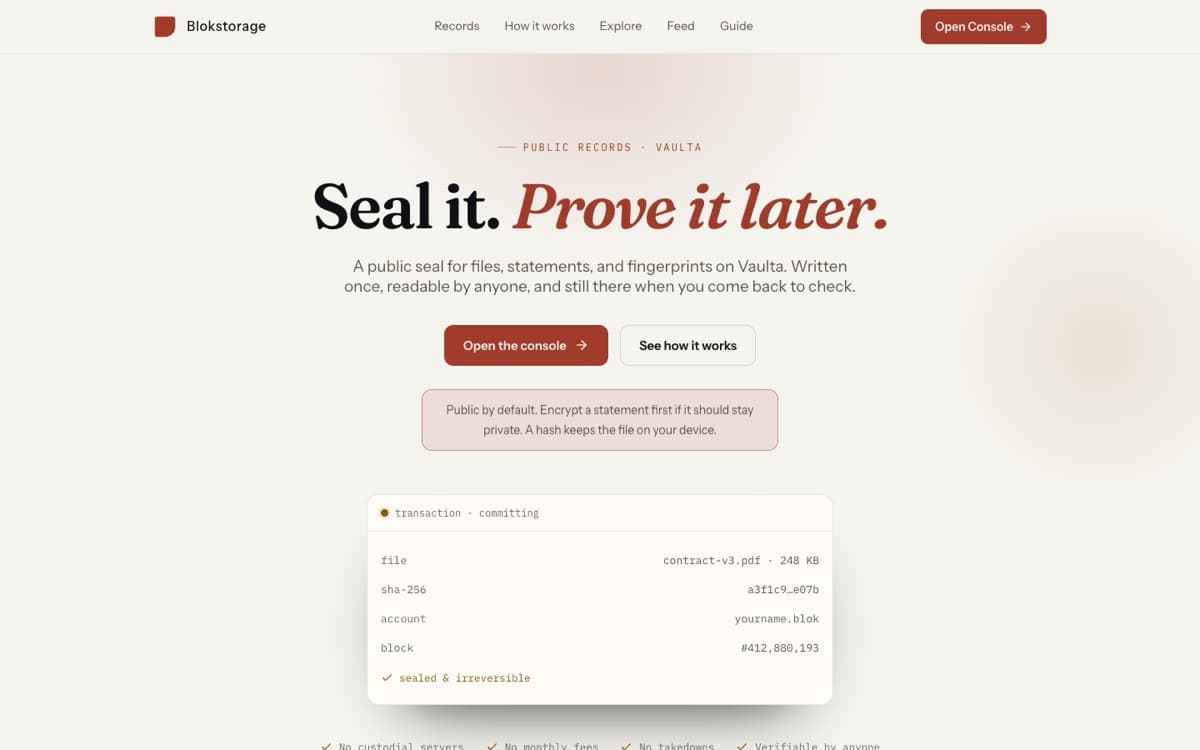
Blokstorage.io introduces a verification-first system that allows users to generate immutable proof records for any digital file. By creating cryptographic fingerprints (hashes) and anchoring them on-chain, the platform ensures that files can be independently verified without exposing their contents.
Instead of storing files directly, the system focuses on three core guarantees:
- Proof of Existence: Verifying that a file existed at a specific timestamp
- Integrity Assurance: Ensuring that the file has not been modified
- Public Verifiability: Providing a verification link that can be independently checked by any third party
Key capabilities include:
- Multi-Format Encoding Support: Files can be processed using ZIP + Base64, Base85, or Base91 to optimize verification workflows
- Verification Links: Each file generates a persistent, shareable proof that can be validated by third parties
- Smart Verification: Automated verification across encoding methods to simplify the validation process
- Contract-Based Storage Layer: Proof metadata is stored on-chain, ensuring immutability and transparency
- API and Console Access: Users can integrate verification directly into workflows via the platform console and APIs
This approach transforms any file, from legal documents to datasets or images, into verifiable, tamper-proof evidence. The system does not require trust in the issuer, the platform, or the storage provider. It relies only on the proof itself.
Architecture and Engineering Direction
Blokstorage is architected as a verification infrastructure layer rather than a traditional storage system. The platform separates file handling from proof generation logic, ensuring efficiency, privacy, and scalability.
- Hash-Based Proof System: Files are reduced to cryptographic hashes, enabling verification without exposing content
- On-Chain Anchoring: Proof records are stored on blockchain infrastructure to ensure immutability and public auditability
- Encoding Abstraction Layer: Multiple encoding strategies enable compatibility with different file types and verification methods
- Decoupled Storage Model: Files are not required to be stored on-chain, reducing cost and improving performance
- Verification Engine: A flexible system capable of validating proofs across different encoding schemes
- API-First Design: Enables integration with external systems such as CI pipelines, document platforms, or automation tools
This architecture allows Blokstorage to function as a foundational trust layer that can be embedded into existing workflows rather than replacing them.
What Can Be Learned from This Approach
The Blokstorage architecture provides a reference for designing systems where verification must be independent of storage, ownership, or platform-level trust.
Key takeaways include:
- Decoupling verification from storage: Treating proof generation as a separate layer, allowing files to remain off-chain while still being independently verifiable
- Content-agnostic proof design: Using cryptographic hashes to represent files, enabling validation without exposing or transferring the underlying data
- Immutable anchoring mechanisms: Recording proof metadata on-chain to create timestamped, tamper-resistant verification records
- Flexible encoding abstraction: Supporting multiple encoding strategies to ensure compatibility across different file formats and integration contexts
- Embedded verification workflows: Designing systems that can be integrated into existing pipelines rather than requiring full infrastructure replacement
This approach outlines how verification can be implemented as a portable infrastructure layer that operates independently of storage systems and centralized trust models.