The Problem
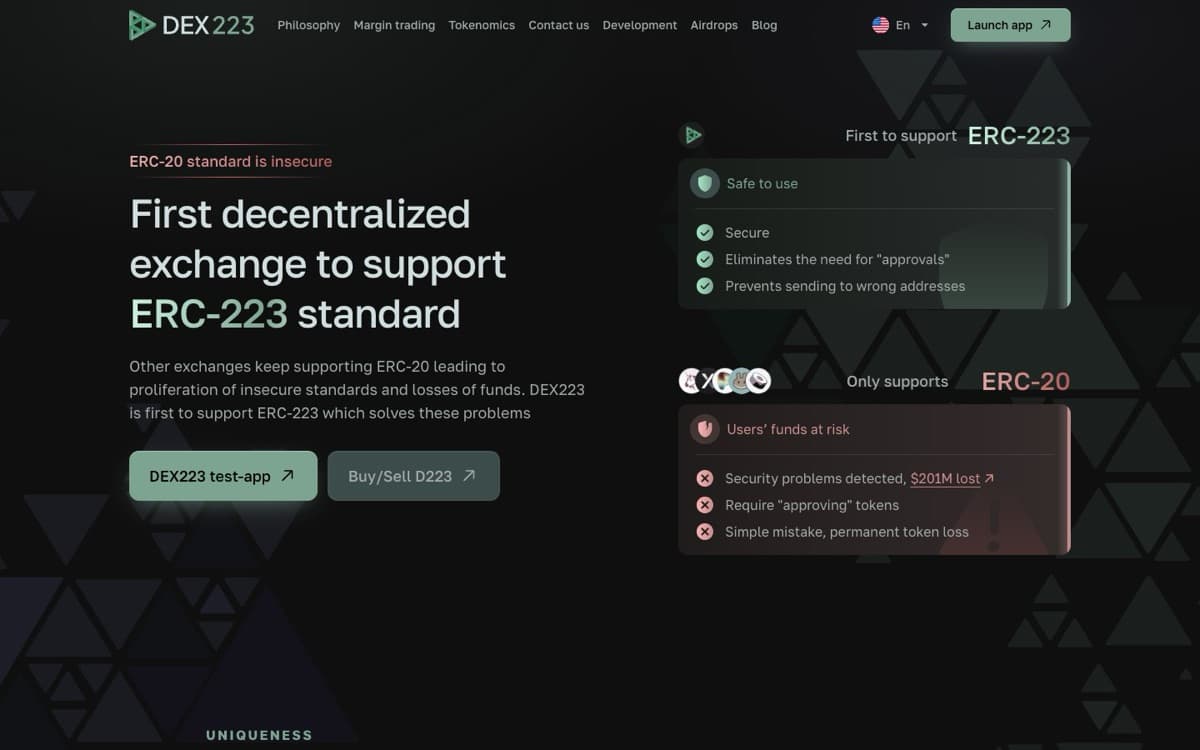
Decentralized exchanges (DEXs) and token standards have historically introduced critical inefficiencies and risks into the DeFi ecosystem. ERC-20 tokens, while widely adopted, lack safeguards against incorrect transfers, resulting in substantial and irreversible loss of funds.
At the same time, many so-called “decentralized” exchanges still rely on centralized elements such as curated listings, admin-controlled interfaces, and off-chain dependencies. This creates friction for token launches, limits market access, and introduces trust assumptions that undermine decentralization.
Additionally, fragmented liquidity between token standards and the absence of native lending or margin capabilities further constrain capital efficiency and financial expressiveness. The net result is a system that is technically decentralized but operationally constrained and risk-prone.
The Solution
DEX223 introduces a fully permissionless, smart contract–driven exchange protocol designed to eliminate these structural limitations. By inventing and leveraging the ERC-223 token standardan evolution of ERC-20 with built-in safety mechanisms, the platform prevents accidental token loss while maintaining backward compatibility.
Token listing is fully automated through smart contracts, removing gatekeepers and enabling instant market creation.
The system integrates trading, lending, and margin functionality directly into the protocol layer, eliminating reliance on external DeFi services. Combined with support for both ERC-20 and ERC-223 tokens and unified liquidity pools, DEX223 delivers a more secure, efficient, and composable exchange environment.
Architecture and Engineering Direction
DEX223 is architected as a fully autonomous, on-chain system where core exchange logic is executed entirely through immutable smart contracts. This smart-contract-first approach ensures trustless operation, censorship resistance, and deterministic execution.
The protocol is modular by design: the user interface is decoupled from the backend, allowing any third party to build alternative frontends without altering core functionality. Listing mechanisms are extensible, with multiple contract types supporting different fee structures and enabling developers to deploy custom market logic.
The system also incorporates native financial primitives such as lending and liquidation (encapsulated margin trading), coordinated through incentive-driven actors rather than centralized services. By merging liquidity across token standards and enabling multi-chain deployment, the architecture prioritizes scalability, extensibility, and long-term protocol resilience.
What Can Be Learned from This Approach
The DEX223 architecture provides a practical reference for addressing common limitations in decentralized exchanges, including unsafe token transfers, fragmented liquidity, and reliance on centralized components.
Key takeaways include:
- Safer token interaction models: Embedding safety guarantees at the token standard level reduces systemic risk across all interacting protocols
- Permissionless market creation: Automating market infrastructure removes coordination bottlenecks and reduces reliance on governance or intermediaries
- Protocol-level financial primitives: Integrating core financial functions at the protocol layer improves composability and reduces dependency chains
- Unified liquidity design: Abstracting differences between token standards enables deeper liquidity aggregation and more efficient capital utilization
- Fully on-chain execution: Minimizing off-chain dependencies strengthens determinism, auditability, and trust minimization
This approach outlines a direction for building more autonomous, composable, and secure decentralized exchange infrastructure within EVM-compatible environments.